
As many know, becoming a doctor in any medical specialty takes more than academic knowledge, it also requires real experience and genuine commitment. Starting preparation early gives students the time they need to plan and build readiness in every area, step by step. Let's explore the path to Thailand's and the world's leading medical schools, along with the specialized curriculum designed for future doctors.
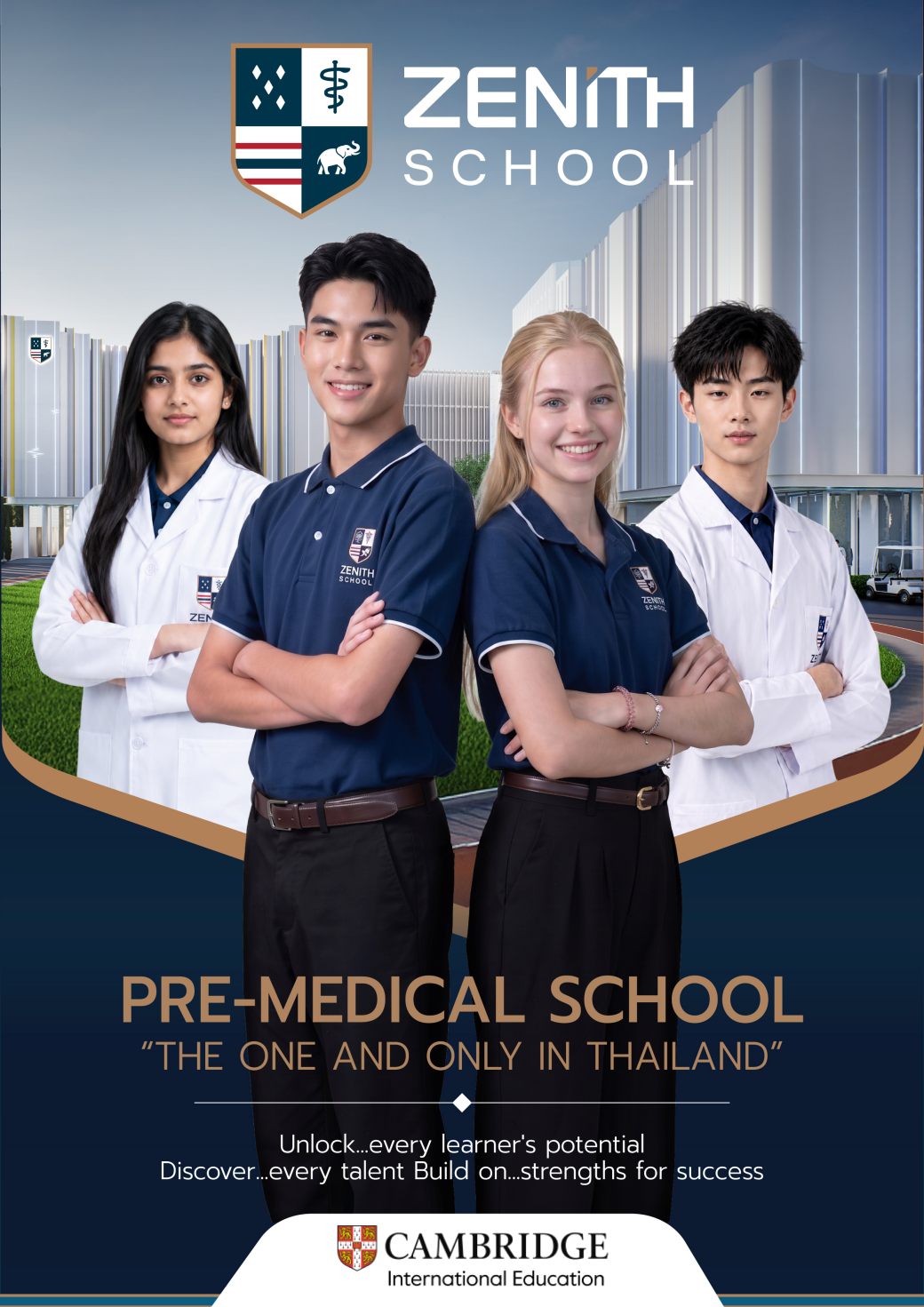
Zenith School is Thailand's only secondary school dedicated to pre-medical preparation. It designs a personalized learning journey to help students plan their path toward medicine and health sciences, both in Thailand and abroad — from goal-setting and academic development to exam preparation, real-world experience, portfolio planning, and the application process itself.
What Do You Need to Study to Become a Doctor? How Many Years Does It Take?
Medical school in Thailand is typically a 6-year program, which is why building the right foundation from secondary school matters, both academically and in the practical skills medicine demands.
Key subjects to focus on include:
- Biology: understanding living organisms, body systems, and biological processes
- Chemistry: a core foundation for medical science and biochemistry
- Physics: building an understanding of scientific principles and their real-world applications
- Mathematics: developing systematic thinking, calculation, and analytical skills
- English: essential for research, exams, and international-curriculum study
At Zenith School, learning goes beyond core subjects to include specialized medical and health science topics such as Anatomy, Physiology, and Medical Microbiology, along with hands-on laboratory work and workshops giving students a genuine introduction to the medical profession as early as secondary school.
What Exams Do You Need to Get into Medical School?
University admissions in Thailand currently run through the TCAS system, which offers four application rounds for students interested in medicine. Each round has its own requirements and scoring criteria, as outlined below.
Round 1: Portfolio
The first TCAS round is a portfolio-based application, best suited to students who have built a strong pre-medical portfolio through their academic record, achievements, and awards during secondary school along with an English proficiency score that meets the required benchmark. Requirements for this round generally include:
- A cumulative GPA (GPAX) of at least 3.50, with GPA in science, math, and English subject groups meeting each university's specific requirements (criteria vary by institution)
- An English proficiency score such as IELTS or TOEFL that meets the required benchmark
- A UCAT score
- A compelling portfolio academic achievements, awards or scores from academic olympiads, community service, sports, arts, and leadership experience such as student council president, student committee member, or class leader
Round 2: Quota
The Quota round generally favors students who reside in the province where the university is located, and uses GPAX, A-Level, TGAT, and TPAT scores or other criteria set by each program.
Round 3: Admission (coordinated by the Consortium of Thai Medical Schools, กสพท.)
The Admission round selects students through the TCAS system, with the weighting of each score depending on the program. For medical faculties participating in the Consortium of Thai Medical Schools (กสพท.) selection process, A-Level and TPAT1 scores are used according to the published criteria, as follows:
- A-Level scores — 70% of the total, broken down as:
- Science (Physics, Chemistry, Biology) — 28%
- Mathematics 1 — 14%
- English — 14%
- Thai — 7%
- Social Studies — 7%
- TPAT1 score — 30%, split evenly across three sections: Reasoning Ability, Medical Ethics, and Connective Reasoning (10% each)
Some universities that are not part of the กสพท. consortium also run their own direct-admission rounds.
Round 4: Direct Admission
This is an independent direct-admission round, typically open to students who were not admitted earlier or who were placed in a program that isn't their first choice and want to reapply. A limited number of universities may still have places open in medical programs at this stage. Requirements vary by university and may include GPAX, UCAT, TGAT, TPAT, or A-Level scores.
What Is TPAT1? Why Should Aspiring Medical Students Prepare for It?
TPAT1, the professional aptitude test for medicine, is a critical component for students aiming for medical school through the กสพท. consortium system. The exam is divided into three main sections:
- Reasoning Ability: measures thinking, analysis, and problem-solving
- Medical Ethics: measures judgment and decision-making in given scenarios
- Connective Reasoning: measures the ability to identify key points and analyze relationships between pieces of information
Note: Students should always check the latest official announcements regarding exam structure, schedules, and selection criteria, as details are subject to change.
Understanding the UCAT: Another Key Test for Medical School Applicants
The UCAT (University Clinical Aptitude Test) assesses aptitude and decision-making. It is divided into four sections:
- Verbal Reasoning: analyzing information from written passages (44 questions, 22 minutes)
- Decision Making: making judgments and reasoning through complex information (35 questions, 37 minutes)
- Quantitative Reasoning: solving numerical problems using tables and graphs (36 questions, 26 minutes)
- Situational Judgement (SJT): assessing scenarios and appropriate decision-making (69 questions, 26 minutes)
UCAT preparation should start early and involve consistent practice, building analytical thinking, time management, and decision-making skills tailored to each student's own path toward medicine.
Preparing for Medical School at Zenith School, Starting from Secondary School

For students who dream of becoming a doctor or parents who see that dream in their child — early preparation from secondary school gives students the time to build readiness step by step, in every area that matters. Zenith School, Thailand's only secondary school for pre-medical and health science preparation, designs a personalized learning path: from discovering interests and strengths, to setting goals, developing academics and experience, and preparing a portfolio and interview skills helping each student chart a path to medical school that truly fits them.
Discover Your Interests and Set Learning Goals
Before beginning preparation for medical school, students first need to understand what genuinely interests them, where their strengths lie, and what direction they want to pursue. Zenith School places strong emphasis on discovering individual interests and setting personal goals, using tools like CliftonStrengths® and VARK Learning Styles to help students understand their strengths, learning style, and areas for growth — all of which inform a learning plan and activities tailored to each student.
Build Academic Skills and Gain Essential Experience
Once goals are clear, students can plan their academic development to match their chosen path — building foundational knowledge and preparing for exams such as IELTS, UCAT, A-Level, and TPAT1, along with other relevant tests. Progress is tracked continuously through Mock Tests for students in Grades 10–12 (M4–M6), helping identify strengths and areas that need more focus.
Beyond academics, Zenith School also gives students the chance to learn through real activities and experiences: medical camps, community service, academic competitions, and research projects — helping build analytical thinking, communication, and teamwork skills, while allowing students to discover their interests through hands-on experience.
Plan Your Portfolio and Prepare Application Documents
Portfolio preparation should begin early, giving students time to build a body of work and experience aligned with their goals. Zenith School helps guide the whole process from gathering and selecting achievements, to organizing information, to building a profile that reflects each student's interests, abilities, and growth. Students are given opportunities to build experience through activities such as:
- Pre-medical Workshops
- Laboratory sessions
- Research projects
- Academic Competitions
- Medical Projects
- Community service
- Medical Camps and other health-related experiences
How Does Zenith School Help Plan a Portfolio?
The process starts by setting a clear goal: where does the student want to apply, and what qualities is that university looking for? From there, the school plans the right experiences, selects the strongest achievements, and organizes the narrative to reflect the student's identity and growth. This is supported by a Tech-Driven Mapping system that consolidates scores, achievements, activities, and qualifications to build each student's Individual Roadmap, along with preparing key documents such as a Personal Statement, Clinical Hours record, and Medical Paper.
Zenith School also runs Mock MMI (Multiple Mini Interview) sessions and Interview Simulations, giving students practice answering questions in scenarios similar to the real exam covering communication, analytical thinking, decision-making, and medical ethics all supported by one-on-one coaching to review strengths and areas for improvement.
Personalized Coaching and University Pathway Planning
Beyond academic and exam preparation, Zenith School provides one-on-one coaching to help students understand themselves, revisit their goals, and plan a learning path aligned with their interests and potential. This helps students see the connections between their strengths, interests, academics, activities, experience, and future goals all feeding into a well-structured portfolio and a clear path toward university and career. Teachers and coaches listen, ask the right questions, and support students in finding the answers and direction that fit them best, while continuously tracking and reviewing progress so the plan can adapt as each student grows.
Becoming a Doctor Starts with Thorough, Well-Rounded Preparation
Preparing for medical school doesn't mean rushing to learn everything at once — it means building readiness gradually, in a way that fits each stage of a student's growth: from academic foundations and discovering personal interests, to gaining experience through activities, to preparing a portfolio and taking university entrance exams.
At Zenith School, Thailand's only pre-medical school, the curriculum is designed to connect every step — from potential analysis and personalized learning, to coaching and real-world experience — helping students steadily build readiness and plan toward their university and career goals. Rather than focusing on test scores alone, Zenith School prioritizes each student's long-term growth, so every student can move toward their dream faculty and future career with confidence.